
Claude Code vs Codex (2026): Why I Switched to Claude Code
I used Codex with Astra full time. Then Opus 5.5 shipped and I switched to Claude Code. One week of real usage limits, prices, and how I run both.
I use Claude Code for nearly everything, and I think you should too. I use it with the Claude Max plan, but the lower plans will probably last for most people. Opus 5.5 is the best coding model right now and the Claude plans give far more usage for the money. I keep Codex for one job: reviewing very large diffs with GPT-6 Astra, since the two models have different blind spots.
TL;DR
- Best for daily coding: Claude Code with Opus 5.5 on a Claude Max plan ($100 or $200 a month). Opus 5.5 has been Claude Code's default since September 22, 2026.
- Best harness: Codex. Open source under Apache 2.0, it queues your next message while it works, and it has used AGENTS.md since launch.
- Best for reviewing huge diffs: Codex with GPT-6 Astra as a second opinion. It usually finds 1 to 2 things Opus disagrees with on my big changes.
- Best value: Claude Max. My estimate, not a measurement: my Claude plan is worth 10 to 30x more to me than my ChatGPT Pro plan.
- Want both, or want to switch when the best model changes? Cloudroom runs Claude Code and Codex side by side with your own subscriptions.
Is Claude Code better than Codex?
For daily work in September 2026, yes. Claude Code has the better default model and the better subscription, so it wins where I spend 95% of my time. Codex is the better harness, and it keeps the one job it genuinely does better.
The model gap appeared twice this month. OpenAI shipped GPT-6 Astra on September 3, 2026, and it became available in Codex immediately. Anthropic answered with Opus 5.5 on September 22, 2026 and made it Claude Code's default the same day. Anthropic reports Opus 5.5 at 66.4% on Terminal-Bench 4.0 against 57.9% for GPT-6 Astra, an 8.5 point lead. Those are vendor numbers, so treat them as directional. The direction matches my daily experience: Opus writes and plans everything, and I stopped having to argue with the output.
Independent tests point the same way. Composio ran both harnesses through 30 identical tasks with the same MCP setup. The result was a tie on quality at 16 of 30 passed each, but Claude Code finished in about half the median time, 122.7 seconds against 245.0, using 358 tool calls against Codex's 448. Firecrawl's roundup of longer tests found the same pattern: Claude Code is faster on simple and medium tasks, Codex is slower but more thorough on complex ones.
That thoroughness is why I still keep Codex. Astra is the best review model I have used. Coderabbit's evaluation measured it catching about 4% more labeled bugs than GPT-5.6 Sol and 22% more than Opus 5, with a bigger lead on hard cross-file changes. Endorlabs found the cost of that thoroughness: Astra takes about 1.8x the wall-clock time of GPT-5.6 Sol on the same tasks. That is exactly why Opus writes and Astra checks.
| Claude Code | Codex | |
|---|---|---|
| Default model | Opus 5.5 since September 22, 2026 | GPT-6 Sol recommended; GPT-6 Astra selectable (shipped September 3, 2026) |
| Model price, API | $4 input, $20 output per million tokens | Sol $2/$10; Astra $10/$50 per million tokens |
| Plans | Pro $20 a month ($17 on annual), Max 5x $100, Max 20x $200 | Free $0, Go $8, Plus $20, Pro 5x $100, Pro 20x $200 |
| Limits | 5-hour window plus a weekly cap, shared across Claude chat and Claude Code; no absolute numbers published | 5-hour window plus a weekly cap, shared across Work and Codex; per-model message ranges published |
| Usage in practice, my one week | Claude Max 20x: 20% of the weekly limit after heavy daily use | ChatGPT Pro 20x: 51% of the weekly limit after a few big-diff reviews |
| Open source | No | Yes, Apache 2.0 at github.com/openai/codex |
| Message queue | Steering only: what you type joins the current turn after the next tool call finishes; you can't hold it for the next turn | Tab queues your next message for the next turn; Enter injects into the current run |
| AGENTS.md | Reads it since v2.1.277 (September 2026), but only when no CLAUDE.md exists | Since launch in April 2025, and /init generates one |
| Speed, identical 30-task run (Composio) | 122.7 s median, 358 tool calls | 245.0 s median, 448 tool calls |
| Best for | Daily coding, long sessions, the most usable hours per dollar | Reviewing large changes as a second opinion, cheap entry plans, an open harness |
Which is cheaper, Claude Code or Codex?
Per task, Codex is cheaper in theory. Per hour of real work, Claude Code wins, and for heavy use the difference is not close.
The plan prices now mirror each other. Claude Code comes with Pro at $20 a month ($17 on annual), Max 5x at $100, and Max 20x at $200. Codex has a real free tier, Go at $8, Plus at $20, then Pro 5x at $100 and Pro 20x at $200. OpenAI paused new Pro 20x signups on September 10, 2026, so right now that tier exists mostly for people who already have it.
On raw token cost Codex is cheaper. Its recommended model, GPT-6 Sol, lists at $2 input and $10 output per million tokens, half of Opus 5.5's $4/$20. Astra, the model I run in Codex, is the expensive one at $10/$50. Composio's 30-task run cost $1.29 with Codex against $3.12 with Claude Code, around 58% less, at an identical pass rate. So if you pay per token and your task is self-contained, Codex is the cheaper tool.
Subscriptions flip that. Both companies sell usage windows: a five-hour window plus a weekly cap, Claude's shared across chat and Claude Code. OpenAI publishes estimated message ranges per five-hour window for each model, 100 to 900 local Astra messages on Pro 20x, 25 to 225 on Pro 5x. Anthropic publishes no absolute numbers at all, which is its own problem. But my Claude Max 20x plan has been basically impossible to use up in practice. My estimate is that the Claude plan is worth 10 to 30x more to me than my ChatGPT Pro plan, because Opus keeps up with how much I actually work.
How much usage do you actually get? My numbers from one week
Here is my real week. Claude Max 20x showed 20% of the weekly limit used with 20h 35m left before the reset, roughly 88% of the way through the week. That covered Opus writing and planning everything across heavy daily use, including making dozens of videos and editing a 1.5-hour podcast from scratch. ChatGPT Pro 20x showed 51% of the weekly limit in the same week, and all I did with it was a few reviews of large diffs with Astra.
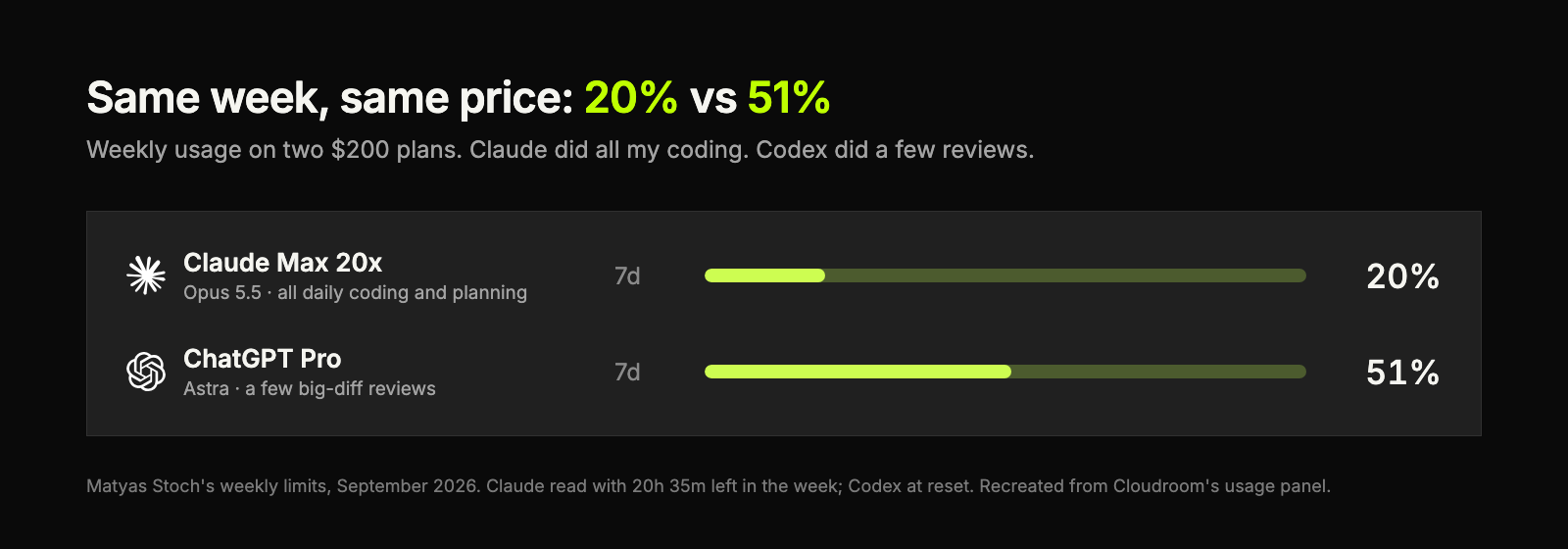
Recreated from my September 2026 usage panels, not a screenshot, because my Codex limit had already reset: Claude Max 20x at 20% of the weekly limit with 20h 35m before reset, ChatGPT Pro 20x at 51% after a few big-diff reviews.
Part of the gap is Astra itself. OpenAI's own help pages say Astra "can use your allowance faster than GPT-5.6 Sol," and it does. The model is slow in two ways: it burns tokens per task, and its output tokens come out slowly. Opus 5.5 answers faster and is mostly better, so reviews are the only place I pay Astra's price.
Codex's cheaper recommended model, GPT-6 Sol, is not the answer either. It is not a very good model, and I would not use it over Opus 5.5 for anything.
David, Cloudroom's founder, ran this experiment at a larger scale. Before Opus 5.5 he kept 6 ChatGPT Pro plans at once and cycled through one per day while building Cloudroom, because a single Pro plan barely covered a full day of Codex work. Now he runs one Claude Max plan and one Codex Pro plan. He ships more per day than before and still cannot reach the Claude limit. His Codex limit runs out faster than his Claude one even though he barely uses Codex, only for reviews of big changes.
Can you use Claude Code and Codex together?
Yes, and on large changes you should. On ordinary work you should not, because Opus alone is good enough and you would just be slowing yourself down.
My workflow is two roles. Opus writes and plans everything in Claude Code. For very large changes only, Astra reviews the result in Codex at the end. It usually finds 1 to 2 things it disagrees with. Opus checks them, usually agrees, and fixes them. That is the whole loop, and it works because Anthropic and OpenAI models have different blind spots. A disagreement you get out of Astra is often exactly the blind spot Opus could not see, and the reverse is true too. I have no single dramatic bug story to offer. It has simply held true for months.
Again, for 99% of work I would not recommend the double review. The second model costs usage, time, and attention, and Opus alone is good enough almost every day. I also occasionally use Astra for copywriting, but rarely.
Which harness is better: Claude Code or Codex?
Codex. If Codex ran Claude models on a Claude subscription, I would prefer it over Claude Code.
Start with the open source question. Codex CLI is open source under Apache 2.0 at github.com/openai/codex, written in Rust, and I do not miss any major feature in it. Claude Code is closed source, and that is a real cost: you cannot inspect what it sends, and heavy users report that it sends a lot. Matt Pocock's walkthrough of trimming his Claude Code system prompt opened with "Fuck, there is so much cruft in there," and Nathan Wilbanks measured "~6,800 EXTRA tokens" added per message. These are user reports, not verified facts, but I believe them.
Message queuing is a second difference, and the exact behavior matters. In Codex, press Tab while it runs and your message queues as your next turn. Enter injects into the current run. Claude Code only has steering: type while Claude works and your message is sent as soon as the current tool calls finish, inside the same turn. You cannot hold a message back for the next turn. Codex lets you decide: defer to the next turn or steer now. In Claude Code's terminal you take what the turn gives you. A GUI on top of Claude Code is what gives you Codex-style queuing.
AGENTS.md tells the same story of a late follow. Codex launched in April 2025 with AGENTS.md as its standard (same as every other harness except Claude Code). Claude Code spent a year as the only holdout on CLAUDE.md before adding native AGENTS.md support in v2.1.277 in September 2026, and even then it reads the file only when no CLAUDE.md or CLAUDE.local.md exists. There are settings to change that, but the default is fallback.
But criticize Claude Code all you want, it was the pioneer. It shipped as a research preview on February 24, 2025, months before Codex's April 16, 2025 launch, and it invented the terminal agent workflow everyone else copied. And it has the one advantage that decides everything in practice: Claude Code is the only harness where your Claude subscription works. That is why I, and most heavy users, run it.
How to switch between Claude Code and Codex without changing your setup
I lived in Codex with Astra, then Opus 5.5 shipped and I moved to Claude Code. The next model release could flip that again, and if it does I will switch same day. So I do not lock my workflow into one harness, and neither should you.
That is why Cloudroom exists. It runs Claude Code and Codex in one app with your own subscriptions, adds a message queue on top of Claude Code sessions, and lets me run the Opus-writes, Astra-reviews workflow in one place instead of two terminals. Each agent gets its own cloud sandbox, so nothing I build depends on one vendor's next release. If you also steer sessions from your phone, our Claude Code Remote Control guide covers what works and what dies when your laptop sleeps.
Models trade the lead constantly. Buy monthly plans only, and keep your cost of switching low.
Which should you pick?
- You code all day and want the best model: Claude Code with Max 5x ($100) or Max 20x ($200). This is my setup.
- You are on a budget or just starting: Codex's free tier, then Claude Pro at $20 a month with Sonnet 5.5.
- You want a second opinion on very large changes: both. Opus writes in Claude Code, Astra reviews in Codex. Skip the second pass on normal work.
- You want an open harness, kernel sandboxing, or cloud handoff and don't care about not having the best model: Codex.
codex cloudruns tasks in reproducible cloud environments and returns a branch to review. - Your work has to survive a closed laptop: neither local install. Read our guide to keeping coding agents running with the laptop closed for the actual options.
- You want to stop choosing, or switch the moment the leader changes: run both in one app with your own subscriptions, so a model swap costs you nothing extra.
If you want both tools without two setups, Cloudroom runs Claude Code and Codex with your own subscriptions, each agent in its own cloud sandbox, and it is how I stop caring which one wins next month. Join the waitlist, or start with the laptop-closed guide.
A FEW DETAILS
Questions, answered.
Which is better in 2026, Claude Code or Codex?
For daily coding, Claude Code, because Opus 5.5 is the better model and the Claude Max plans stretch further under heavy use. For reviewing very large diffs, Codex with GPT-6 Astra, because Astra catches different problems. If you can only afford one, buy Claude Code.
Is Claude Code better than Codex for beginners?
Yes, once you can pay $20 a month. If you cannot pay anything yet, start with Codex's free tier. As soon as you can, move to Claude Code on the $20 Pro plan and use Sonnet 5.5 to make the limits last, then step up to Opus 5.5 and a Max plan when you outgrow it. You will learn more from the better model than from the cheaper harness.
Which is cheaper, Claude Code or Codex?
Per task, Codex. Its recommended model costs $2/$10 per million tokens against Opus 5.5's $4/$20, and Composio measured the same 30-task run at $1.29 with Codex versus $3.12 with Claude Code. Per hour of heavy daily work, my Claude Max plan wins, and by a wide margin: in my measured week I used 20% of my Claude weekly limit and 51% of my ChatGPT Pro limit while using Claude far more.
What model does Claude Code use by default? What model does Codex use?
Claude Code defaults to Claude Opus 5.5 on Pro, Max, Team, Enterprise, and API accounts since September 22, 2026. Codex recommends GPT-6 Sol, its cheaper standard model, and you switch to GPT-6 Astra with /model. Astra shipped September 3, 2026 and is what I use for reviews.
Can I use Claude Code and Codex together?
Yes, and it is the workflow I recommend for very large changes: Opus writes and plans in Claude Code, Astra reviews at the end in Codex. For normal work a double review is not worth it, since Opus alone is good enough. Cloudroom runs both harnesses with your own subscriptions, which removes the two-terminal overhead.
Does Claude Code support AGENTS.md?
Yes, since v2.1.277 in September 2026, but only as a fallback: Claude Code reads your AGENTS.md when no CLAUDE.md or CLAUDE.local.md exists in the project, and ignores it once a CLAUDE.md is present. A setting changes the default. Codex has read AGENTS.md since its launch in April 2025.
Why does my ChatGPT Pro limit in Codex run out so fast?
Because the newest models draw down the shared weekly allowance at very different rates. OpenAI's own help pages say Astra "can use your allowance faster than GPT-5.6 Sol," and both the five-hour window and the weekly cap must have allowance left. In my measured week, a few big-diff reviews with Astra consumed 51% of a Pro 20x weekly limit. Unfortunately, GPT-6 Astra is the only OpenAI model I think is worth using right now.
Is Claude Code open source?
No. Claude Code is closed source, which means nobody can audit what it sends to the model. Codex CLI is the open source one, Apache 2.0 at github.com/openai/codex.